DCA
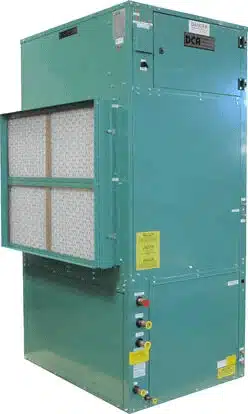
DCA Vertical Dehumidifiers
Space-Efficient Commercial & Industrial Dehumidification Systems from 1.5–8 Tons
DCA vertical dehumidifiers provide dependable humidity control in a space-efficient configuration for commercial and industrial applications. Manufactured in Cedarburg, Wisconsin, these systems offer 1.5–8 ton capacities and airflow from 650–3,600 CFM.
Designed for indoor installation, DCA vertical units combine reliable moisture removal with configurable heating, heat-rejection, and air-side options.
Highlights
- 1.5–8 ton capacity range
- 650–3,600 CFM airflow
- Space-efficient vertical construction
- Indoor-rated equipment
- Multiple heat-rejection options
- Non-proprietary controls and components
Additional Information
Description
DCA vertical dehumidifiers provide commercial and industrial moisture control where a vertical equipment configuration better suits the available mechanical space or installation requirements.
Eight available models support different airflow and humidity-control needs. These indoor-rated units can be configured for pool rooms, commercial buildings, replacement installations, and specialized applications.
Manufactured in the United States, DCA systems incorporate serviceable components and practical equipment designs that support long-term operation.
Key Features of DCA Vertical Dehumidifiers
Space-Efficient Configuration
Vertical cabinet construction accommodates indoor installations where equipment footprint and duct arrangement are important.
Multiple Capacities
Eight models provide 1.5–8 ton capacities and 650–3,600 CFM airflow.
Standard Reheat Condenser
Returns heat to the discharge air to support conditioned-air delivery.
Multiple Heat-Rejection Options
Remote air-cooled, pool water heating, and water-cooled configurations are available.
Supplemental Heating
Electric duct heaters, gas duct furnaces, and external hot water coils support application-specific heating needs.
Flexible Air-Side Options
Multiple supply arrangements, fresh-air openings, and filtration options support integration with existing systems.
Benefits of DCA Vertical Dehumidifiers
DCA vertical systems combine controlled moisture removal with a practical, space-efficient design.
Their configurable heat-rejection and heating options help facilities maintain stable indoor conditions while addressing installation limitations. Non-proprietary controls and serviceable components simplify long-term maintenance planning.
For applications requiring larger capacities or outdoor installation, DCA also offers horizontal dehumidifiers within Lincoln’s broader industrial dehumidification solutions.
DCA Vertical Dehumidifier Specifications
| Model | Tonnage | CFM | Moisture Removal (lbs/hr) | Net Sensible Cooling |
|---|---|---|---|---|
| DCA650Y V & WH | 1.5 | 650 | 7.5 | 8.5 MBH |
| DCA900Y V & WH | 2 | 900 | 11.4 | 12.4 MBH |
| DCA1500Y V & WH | 3 | 1,500 | 17.2 | 18.5 MBH |
| DCA2000Y V & WH | 4 | 2,000 | 23.6 | 25.4 MBH |
| DCA2500Y V & WH | 5 | 2,500 | 29.9 | 32.8 MBH |
| DCA3000Y V & WH | 6 | 3,000 | 37.1 | 39.7 MBH |
| DCA3300Y V & WH | 7 | 3,300 | 39.4 | 41.3 MBH |
| DCA3600Y V & WH | 8 | 3,600 | 43.2 | 45.5 MBH |
Applications for DCA Vertical Dehumidifiers

Swimming Pools, Spas & Natatoriums
Manage indoor pool humidity while supporting occupant comfort and optional pool water heating.

Hotels & Hospitality Facilities
Maintain humidity control in hotel pool rooms, recreational spaces, and indoor aquatic environments.

Replacement Dehumidification Systems
Accommodate equipment replacements where vertical cabinet dimensions and installation constraints influence selection.

Water Treatment Facilities
Support moisture management in high-humidity environments where equipment protection is important.

Indoor Growing Facilities
Maintain controlled humidity conditions for indoor agriculture and specialized growing environments.

Custom Commercial Applications
Address application-specific humidity requirements through configurable equipment and system integration.
Why Work with Lincoln Associates for DCA Dehumidification Systems?
Lincoln Associates helps contractors, engineers, and facility managers evaluate DCA vertical dehumidifiers for commercial and industrial applications throughout the Southeast.
Our engineering team supports moisture-load calculations, capacity selection, heat-rejection configuration, supplemental heating requirements, and HVAC integration. From equipment specifications to replacement planning, Lincoln Associates provides guidance tailored to each facility’s operating conditions.
DCA Vertical Dehumidifier Resources


Find the Right DCA Vertical Dehumidifier
Get expert support selecting the appropriate DCA vertical dehumidifier for your facility. Lincoln Associates can help evaluate capacity, airflow, installation constraints, and configuration requirements.